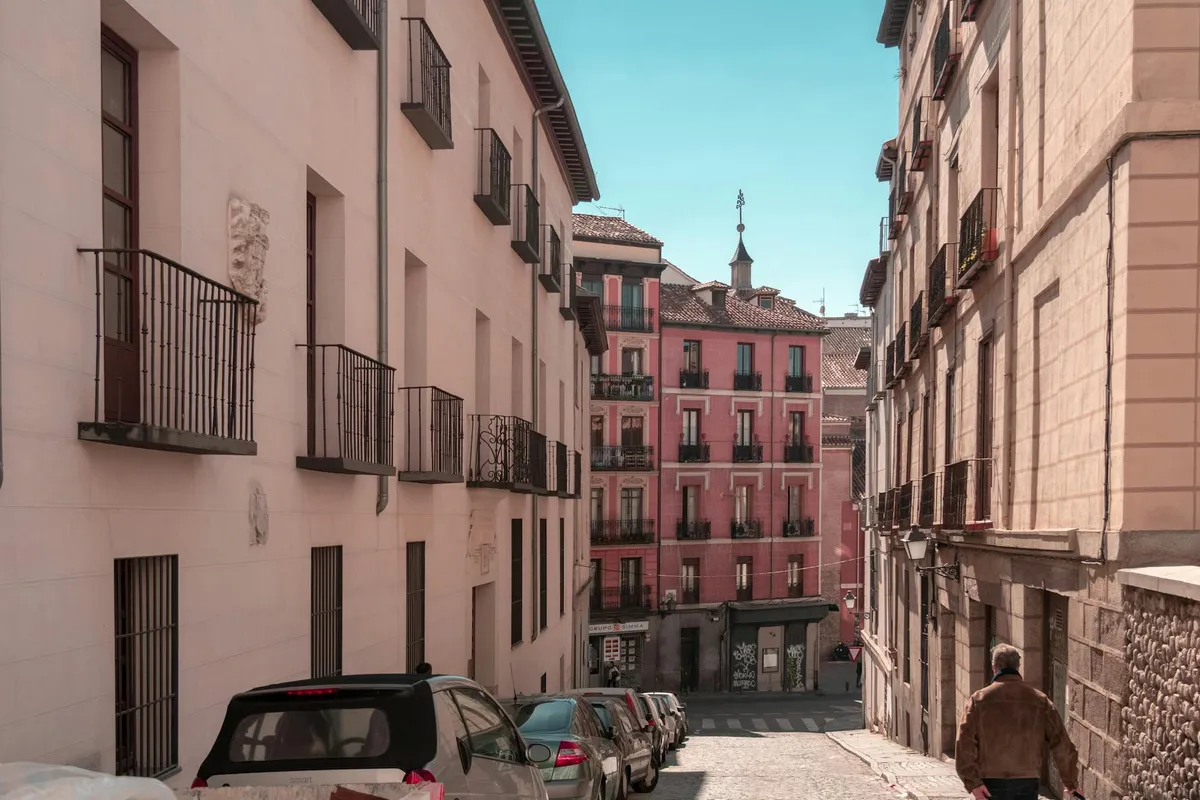
When I started planning my year of slow travel, I knew I wanted to start in Madrid because Madrid is home. What I didn't know was which neighborhood. After research I picked Lavapiés. Three months later I had learned things about Madrid I couldn't have learned in Sol or Salamanca or Chamberí.
Lavapiés isn't the Madrid the postcards show. It's the Madrid that's actually most of Madrid in 2026 — multicultural, layered, complicated, alive.
Here's what living there for three months taught me.
The neighborhood itself
Lavapiés sits south of central Madrid, between Atocha and Embajadores. It's historically a working-class area that's been in transition for decades.
What you see walking through:
Indian and Bangladeshi restaurants and shops along Calle Lavapiés.
African textile shops and food stores along Calle del Ave María.
Spanish bars that have been there for decades, serving the same regulars.
Newer cafes catering to younger residents and the specific creative-class element that's arrived in the past fifteen years.
Apartment buildings whose ground floors house all of the above, sometimes simultaneously.
Streets that change character every two blocks.
The visual experience is dense, layered, frequently striking. Photographs don't capture the feeling of walking through it.
Who actually lives there
The demographic mix is the most distinctive thing about Lavapiés:
Long-time Spanish residents, some of whom have been there for generations.
Substantial Indian, Bangladeshi, and Pakistani populations, with the largest South Asian community in Madrid.
Significant African populations from multiple specific countries.
Younger creative-class residents who've moved in over the past two decades.
Recent immigrants from various places adjusting to life in Madrid.
Specific intellectual and political communities that have historically been associated with the neighborhood.
The mix produces the texture. The neighborhood feels different from anywhere else in Madrid because the population mix is unlike anywhere else.
What you eat there
Food is a substantial part of the Lavapiés experience.
The Indian restaurants are some of the best in Madrid. Specific places I came to know:
Adrish — South Indian, specifically excellent dosas. Proper, not tourist-Indian.
Fang Cha — actually a Chinese place, but worth mentioning because it's one of the few proper regional Chinese restaurants in the area.
Bangla — Bangladeshi specifically rather than generic Indian. The fish curry is genuine.
The traditional Spanish places served different functions:
El Antojo — old-school, neighborhood, the kind of place where you have a small wine and tapa standing at the bar.
Specific small bars whose names I don't remember but whose layouts I can still picture.
The newer cafes filled in another category:
Specific places that opened in the past decade with younger crowds, longer hours, decent coffee.
The food landscape is dense. The variety is substantial. The quality across the spectrum is genuinely high.
What I learned about gentrification
Lavapiés has been gentrifying for decades. Living there for three months made the dynamics more complicated than I'd understood.
What I observed:
The gentrification is real. Specific streets have shifted character substantially in recent years.
The gentrification is uneven. Some streets remain predominantly working-class or immigrant; others are now substantially gentrified.
Some long-time residents welcome aspects of gentrification (improved infrastructure, lower crime). Others resent specific aspects (rising rents, displacement).
The narrative simplification — "gentrification is destroying the neighborhood" or "the neighborhood is finally safe" — both miss the actual complexity.
Specific institutions (community centers, certain restaurants, particular markets) have served as continuity points across the changes.
I came in with one view of gentrification and left with a more complicated one. The simple narratives weren't adequate to what I actually observed.
The Sunday rastro
El Rastro happens just north of Lavapiés on Sundays. It's Madrid's most famous flea market.
What it's actually like for someone who goes weekly for three months:
The first time is overwhelming and exciting.
The second and third times you start to identify which sections sell what.
By month two you have favorite stalls and avoid certain types of vendors.
By month three you're going partly out of routine and partly because the rastro is a substantial weekly social moment.
What I bought regularly:
Old books from the same used book stalls.
Specific small ceramic pieces from a particular vendor I came to know.
Occasional vintage postcards.
What I never bought (despite being there 13 times):
The mass-tourist items being sold to first-timers.
Anything from the streets where the haggling felt theatrical rather than genuine.
The rastro experience changes substantially when you become a regular rather than a one-time visitor.
What I learned about Madrid by living in Lavapiés specifically
Living in Lavapiés taught me things about Madrid that other neighborhoods would not have taught:
Madrid is more multicultural than central Madrid suggests. The tourist Madrid is one specific Madrid. Lavapiés Madrid is closer to actual Madrid demographics.
Madrid's specific cultural texture is layered. Old Spanish patterns, immigrant patterns from multiple specific places, and gentrification dynamics overlap in real-time.
Madrid neighborhoods have specific characters that aren't reducible to "good" and "bad." Each neighborhood has its own logic.
Madrid's creative class lives substantially in non-central neighborhoods. Lavapiés has artistic and intellectual communities that aren't in tourist Madrid.
Madrid's food culture extends well beyond traditional Spanish food. The tapas tour image is partial.
These lessons require living somewhere specific rather than touring multiple places.
What I'd do differently
Things I'd adjust if I were doing this stay again:
I'd rent for four months rather than three. The third month produced the deepest learning. A fourth month would have continued the deepening.
I'd pick a slightly different specific street. My apartment was on Calle Sombrerete which was fine but not optimal. Calle Mesón de Paredes or Calle Argumosa would have been better positioned.
I'd join a specific community activity earlier. I joined a writing group in month three; it would have been better to do this in month one.
I'd eat at home less and at small Spanish bars more. The cooking-at-home pattern I established was fine but missed some neighborhood social experience.
I'd engage more with the specific multilingual community. Substantial communities of Bangla speakers, Wolof speakers, and others were present and accessible.
What I'd tell someone considering Lavapiés
If you're considering Lavapiés for an extended stay:
It's not a tourist neighborhood. The pretty Madrid is elsewhere. Lavapiés is real and complicated.
It works substantially better for stays of a month or longer. Brief visits don't reveal the texture.
The food alone justifies extended stays. The depth and variety are real.
It rewards engagement with specific communities. Pure observation produces less than community participation.
Be ready for the layered character. Lavapiés isn't simple to describe and isn't simple to experience.
Be respectful of long-time residents. Gentrification dynamics are real; behaving thoughtfully matters.
What I'd tell someone who only has time for normal Madrid tourism
If you can't do extended stays but you're visiting Madrid:
Don't skip Lavapiés. Even a few hours produces a different sense of Madrid than purely central tourism.
Walk the main streets — Calle Lavapiés, Calle del Ave María, Calle Mesón de Paredes.
Eat at one Indian restaurant and one traditional Spanish bar.
Go to El Rastro on Sunday morning.
Sit in a specific cafe for an hour and watch the neighborhood pass.
You'll get a glimpse of the multicultural Madrid that pure tourist itineraries miss.
What changed in me
Three months in Lavapiés affected me beyond tourist-style appreciation:
I think differently about cities now. Cities are not the sum of their tourist destinations. Cities are the layered patterns of all their neighborhoods.
I think about gentrification differently. The simplified narratives of either celebration or critique miss the actual complexity.
I think about Spanish identity differently. Spanish-ness in 2026 includes the multicultural patterns I observed, not just the traditional patterns.
I think about my own home neighborhood differently. Watching one place change made me see my home place's changes more clearly.
I plan to return to Lavapiés frequently. Not as a destination but as a continuing relationship with a specific place.
The three months produced something more than a stay. They produced a connection that I expect to maintain for years.
That's what slow travel can produce when it works. The rest of my year of travel followed the same logic. None of it would have been the same as visiting these places. The stays produced relationships rather than memories.
I'm grateful for the experiment. I recommend it to anyone considering trying.